Although a solar photovoltaic (PV) system primarily relies on the sun’s radiation to create electricity, it is still an electrical installation and therefore the standard connections within the installation have to be right in terms of the safety, efficiency and durability of the electrical system. There are a range of tests which help to verify this, including continuity testing, voltage and current testing and insulation resistance testing, but polarity testing is another one of the key tests to be carried out when installing, commissioning and maintaining a solar PV system, and in this guide we will explain why.
The importance of polarity testing in a solar PV array
Polarity testing verifies that the positive and negative connections of the DC cables in the solar PV system are aligned and connected correctly. They need to be connected to other components such as the inverter, charge controllers or the battery. This test therefore carries out an essential safety and efficiency function is ensuring the system is wired and connected properly. The wrong polarity, or cross polarity, as a result of the system being wired incorrectly, can lead to reverse current flow and therefore damage, fire hazards and inefficient performance.
A user who has installed a solar PV system has invested considerable funds in the objective of producing sustainable electricity, and if the system is underperforming, this will mean payback on the initial investment will take much longer. Fundamentally however, the polarity test protects the safety of the solar PV system and plays an important role in safety verification of the electrical installation.
So polarity testing is primarily a diagnostic test to verify that the PV module connections are in the correct orientation. The electrical tester should check the polarity of all DC cables in the installation using suitable test equipment, such as a multimeter or multi-function testers supplied by Test Instrument Solutions for solar PV testing.
How is the polarity test performed?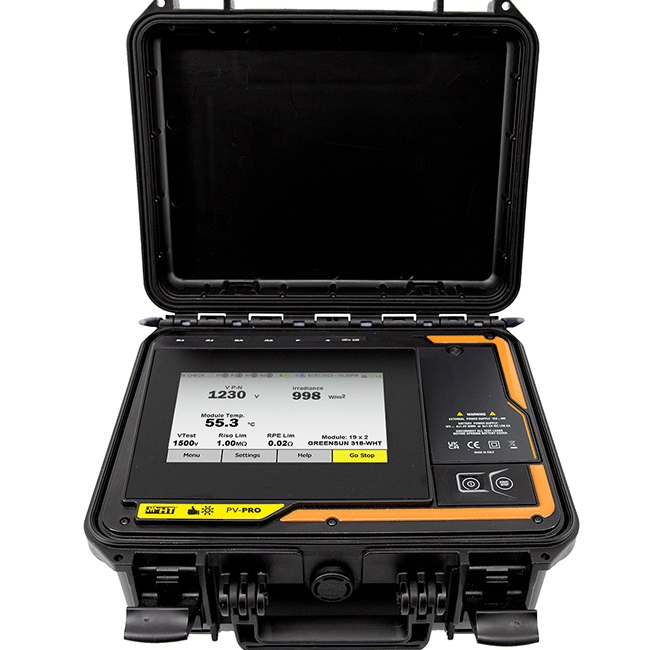
This process should only be performed by a competent & suitably qualified person.
The multimeter or multi-function tester should be set to the DC voltage setting and the red probe should be connected to the positive terminal and the black probe connected to the negative terminal of the solar PV system component. Once a connection is made the instrument should provide a positive voltage reading if the polarity is correct. A negative reading would indicate reverse polarity and an incorrect connection.
Once the correct polarity is confirmed the electrician would also check the cables to ensure they are correctly identified and connected to the correct system devices, such as the inverter. By carrying out polarity testing on a solar PV system we are optimising the efficiency of the system and therefore protecting the client from performance losses. We are also identifying faulty modules or where a string of solar PV panels is faulty. So as well as standard and essential safety verification, polarity testing is a good test to measure the overall reliability and performance of the solar PV system and is therefore an essential feature of any commissioning and ongoing maintenance regime.
If you need to perform polarity testing on a solar PV system you can browse the solar PV test equipment supplied by Test Instrument Solutions.
Please note that this section is for information purposes only. Anyone using equipment referred to in this section must be suitably qualified and/or experienced within the respective field. If in doubt before use, please consult a qualified electrician or engineer & thoroughly read all instruction booklets.