There are a number of systems installed in a commercial business which rely on the efficiency and reliability of airflow, such as compressed air systems, ventilation systems and air conditioning systems. In addition to monitoring HVAC systems, airflow is also a consideration when monitoring internal air quality and also when assessing external conditions, such as on renewable energy wind farms or monitoring whether construction practices are safe. So accurate airflow data is essential for construction site managers, facilities managers, maintenance engineers and energy managers in order to verify conditions, identify issues, optimise performance and reduce operational costs.
It is therefore essential to have a quick, simple and accurate method of measuring and assessing airflow, and this can be done using an environmental test equipment device known as a digital anemometer.
What you need in an airflow measurement instrument
There are several factors which combine to make airflow measurement a complex physics and mathematical puzzle. These include the flow range of equipment (ducts, pipes, hoods and stacks), the cross-sectional area of outlets, air pressure, temperature and humidity. You need an instrument that can allow for these different air conditions and still provide accurate and reliable results, and a digital anemometer does this.
A commercial business would use an anemometer to measure air velocity, wind speed and air pressure. This helps to ensure regulatory compliance as well as managing safety, energy efficiency and maximising the effectiveness of HVAC systems. Modern anemometers are able to:
- Use microprocessors to complete airflow measurements quickly and accurately
- Provide digital readouts in cubic feet per minute and other units of measure
- Provide fast readouts to save time
- Collect and store data for subsequent analysis
How do anemometers work?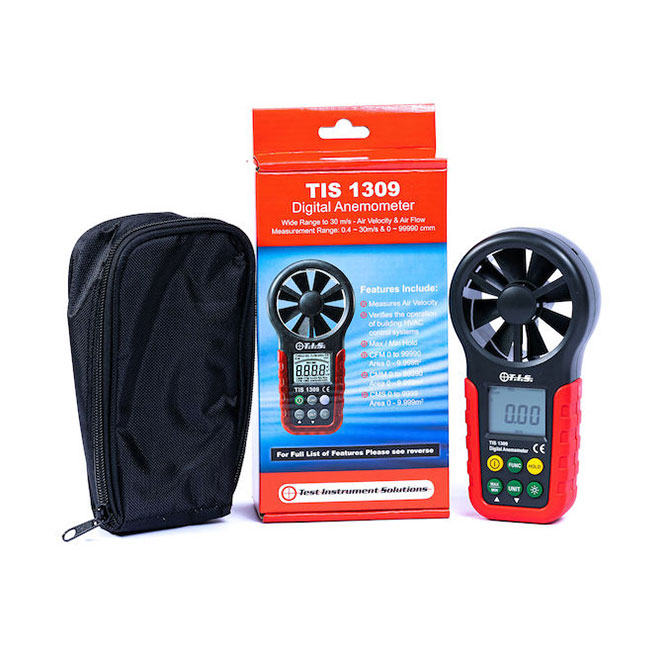
A hand-held digital anemometer, such as the TIS1309 supplied by Test Instrument Solutions, is designed with a circular set of vanes which act like a wind turbine or a windmill to capture air velocity, and use the rotational speed generated to convert it into usable data and readings. So the air velocity generated at a specific point – ie. outside a duct or pipe, produces mechanical rotation which is converted into digital signals by a microprocessor within the anemometer. This produces the raw electronic data that can be data processed to generate usable real-time measurements and readings.
Most digital anemometers will have a digital screen which will display results almost instantly and which can produce readings in various different units, such as metres per second, feet per minute, kilometers per hour, miles per hour and nautical miles per hour. They will display the current reading, but can also provide minimum, maximum and average readings over a period of time, which is essential when accurately monitoring the performance of an HVAC system, or monitoring the safety or environmental suitability of certain locations, because atmospheric conditions will most likely be changing all the time.
The benefits of using a digital anemometer
- High precision results for measuring air velocity
- Readings provided in different units of measure
- Accounts for air conditions such as pressure, humidity and moisture
- Can provide instant results but also can monitor a location over a period of time to produce a range of readings
- Portable, easy to operate and provides simple and easily sharable results
So the most effective way to measure airflow and environmental conditions on site is to use a digital anemometer. This provides real-time data on which you can make accurate decisions to assist with equipment efficiency and maintenance, safe working conditions and environmental performance.
Please note that this section is for information purposes only. Anyone using equipment referred to in this section must be suitably qualified and/or experienced within the respective field. If in doubt before use, please consult a qualified electrician or engineer & thoroughly read all instruction booklets.