Pliers are one of the most popular tools in various professions and particularly in electrical testing. They can be used for gripping nuts and bolts, bending and straightening cabling, splicing two wires together, stripping insulation from wires, crimping metal and cutting wires. There are various different designs when it comes to pliers, and these tend to differ in terms of their individual components, such as the nose or jaws, the type of action, the type of cutters and the handles.
Two of the most popular types of pliers are the combination pliers and the long nose pliers. Here we will explain what each type is and will then explain how they differ from each other.
Combination pliers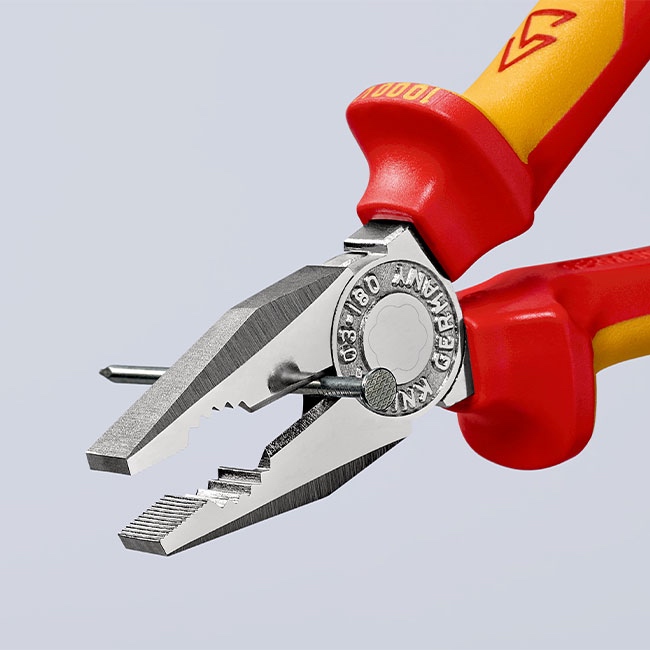
These are a versatile type of pliers which can be used for various tasks, hence the name. They can be used for all the actions listed in the opening paragraph above and so are classed as a multi-purpose tool. Combination pliers tend to be supplied with different handle lengths and nose lengths, and an electrical tester would usually choose a set of combination pliers according to the thickness of wire they can cut, which usually ranges between 2.2mm to 15mm.
Combination pliers can also be supplied with VDE handles, which means they have rubber handles which provide insulation and hence protect the electrical tester from possible electric shock and therefore act as an essential safety feature. Electrical testers also tend to choose combination pliers with shorter handles and jaws, because they are often working in smaller, tighter spaces.
Long nose pliers
Long nose pliers are also popularly used by electrical testers, but for more precise work and for use in areas that are difficult to access. As the name suggests, long nose pliers have longer, thinner jaws and are slimmer and shorter than combination pliers. They are also often referred to as needle nose pliers or pinch nose pliers. So long nose pliers allow the electrician to carry out more detailed work, such as bending, gripping and cutting wires in confined spaces where precision is required.
The main variant with long nose pliers is the handle and jaw size, and again, they can cut different thicknesses of wire according to your needs, these are usually between 1.6mm to 22mm. For extra precision in awkward and difficult to access locations, you can also use bent nose pliers. These are a variation of long nose pliers where the long nose of the jaws is bent at an angle. Long nose pliers can also be supplied with insulated handles for safety in electrical work.
Quality pliers for electrical testers from Test Instrument Solutions
So the main difference between combination pliers and long nose pliers is that combination pliers are a multi-purpose tool with a wider jaw, which is useful for versatility and a wide range of tasks. Meanwhile, long nose pliers are designed for more precise work and more detailed tasks, which are performed in restricted spaces such as an electrical box or panel. You can check out our range of KNIPEX tools at Test Instrument Solutions to see the different types of pliers we have available.
Please note that this section is for information purposes only. Anyone using equipment referred to in this section must be suitably qualified and/or experienced within the respective field. If in doubt before use, please consult a qualified electrician or engineer & thoroughly read all instruction booklets.