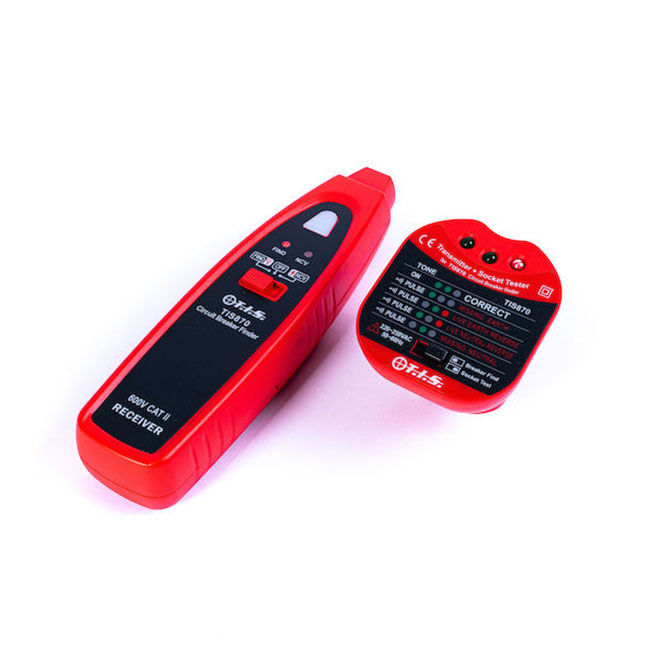
Electrical safety is based around the concept of testing as final confirmation that a system is working effectively, and therefore, safely. A socket tester works on this basis and is an integral instrument for an electrical tester. A socket tester is a small handheld device which is used to provide a fast and effective assessment on whether wall sockets are properly wired and installed and are therefore safe. They are a standard instrument in an electrical tester’s toolbox.
What does a socket tester look like?
The socket tester is plugged directly into a mains socket and hence it looks like a standard plug. However, the front face of the socket tester contains information relating to the testing parameters and the results, in addition to operating buttons and LED light indicators.
What does a socket tester do?
When a socket tester is plugged into a socket it uses three LEDs as a signalling system. These will illuminate in a specific combination in response to the wiring situation. The idea of a socket tester is to identify common wiring issues such as neutral and earth wiring faults, which could cause safety and operational issues.
The purpose of a neutral wire is to connect an electrical circuit back to its source. At the same time, the earth wire directs excess current to the ground from the electrical device. This is essential as a means of reducing the risk of electrical safety issues and damage to the circuit. The socket tester can test each of these connections at the same time. These are all important checks for ensuring a circuit, and the equipment attached to the circuit, are operating correctly.
How does a socket tester work?
A microprocessor is the key feature in understanding how a socket tester works. This is contained within the socket tester and is connected to a conductor circuit. By plugging the socket tester into a socket you are enabling a flow of current. The microprocessor is able to analyse this flow and assess whether there is continuity and polarity in the connections. These are the key indicators of a wiring problem. Using the socket tester, the user is able to confirm that each contact within the socket is connected to the correct wire, ie. neutral and earth. Any wiring faults identified will be displayed on the front face of the socket tester by the LEDs lighting up and, on some models, accompanying audible tones. Usually, if all three LEDs light up, no faults have been detected. However, some models of socket tester indicate results by lighting the LEDs in sequence, or in different colours (red, green and amber). How the LEDs indicate a result will be explained on the front face of the socket tester.
Why are socket testers important?
Socket testers are an important safety mechanism and provide a simple indicator of a wiring fault. They are quick and easy to use and provide a critical first line of defence. However, some models can only detect basic wiring faults and cannot detect some others which are potentially more serious, such as earth neutral reverse, or resistance and impedance in a circuit.
At Test Instrument Solutions we have a range of fuse socket testers available.
Please note that this section is for information purposes only. Anyone using equipment referred to in this section must be suitably qualified and/or experienced within the respective field. If in doubt before use, please consult a qualified electrician or engineer & thoroughly read all instruction booklets.