It is dangerous to make assumptions in electrical testing, and it is therefore essential to verify certain instruments and conditions before performing a test. This is where we need safety controls to provide an important layer of protection and proving units are one such device.
A proving unit is a small portable device that is used to verify measurements taken by test instruments such as two pole voltage testers, digital multimeters or clamp meters. These are instruments which provide safety-critical measurements in electrical maintenance, and often in high-risk environments. So the proving unit ensures the reliability of these measurements by acting as a benchmark to prove the reliability of readings taken, and to therefore reduce operational errors. The proving unit achieves this by using two poles to test an instrument against a known voltage.
How a proving unit works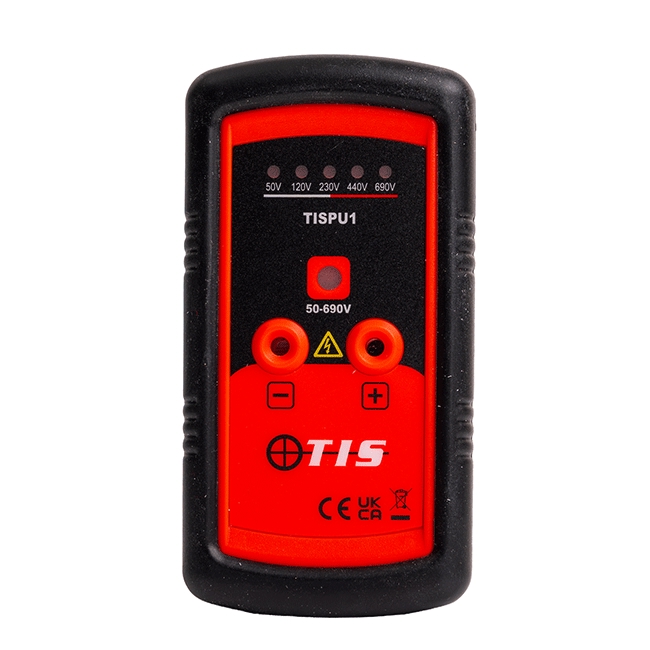
Proving units can test instruments in order to verify the reliability of their measurements, and to confirm that no dangerous voltages are passing through the circuits, and therefore the instruments are working safely. A proving unit is typically a lightweight, battery-powered unit with ports to enable two cable probes to be connected to it.
The user will connect the test probes into the proving unit, the black probe connects with the negative terminal on the test instrument you are using and the red probe connects with the positive terminal. Once this connection is made you should be able to check if the test instrument voltage matches the proving unit voltage. If so, this ensures the device you are using is reliable in measuring voltage. You can repeat this test as many times as you like, or at frequent intervals during testing, to maintain accurate verification.
When would you use a proving unit?
Proving units are used to confirm the reliability of electrical test instruments. Electricians and electrical engineers need to carry out this function to verify safety and to meet regulatory compliance standards before & after each test, following the relevant, prescribed electrical safe isolation process. They can also be used for testing safe isolation of a circuit prior to testing or maintenance work, ie. to verify that a circuit is dead. If a test instrument isn’t working properly, it might produce a reading to say a conductor is dead when it is actually live. The proving unit is therefore an essential back-up to prevent this error occurring, in accordance with the safe isolation process mentioned above.
The benefit of a proving unit is that it is small and lightweight, but also robust. So it can be used in many different environments and is a versatile device even in challenging conditions, such as in industrial settings or when testing high above the ground or in a confined space. It is also a safe way to verify a voltage tester as you don’t have to have any direct contact with potential high voltages. So proving units are used with voltage testers because it is a safe and reliable way to verify a test instrument is working accurately, and that safe conditions exist for electrical maintenance work to proceed.
Always follow the correct, prescribed electrical safe isolation process at all times.
At Test Instrument Solutions we have dedicated proving units such as the TIS PU1, alongside a wide range of voltage testers and safe isolation test equipment.
Please note that this section is for information purposes only. Anyone using equipment referred to in this section must be suitably qualified and/or experienced within the respective field. If in doubt before use, please consult a qualified electrician or engineer & thoroughly read all instruction booklets.