‘Crimping’ is a process used in electrical work to join two pieces of wire together, or to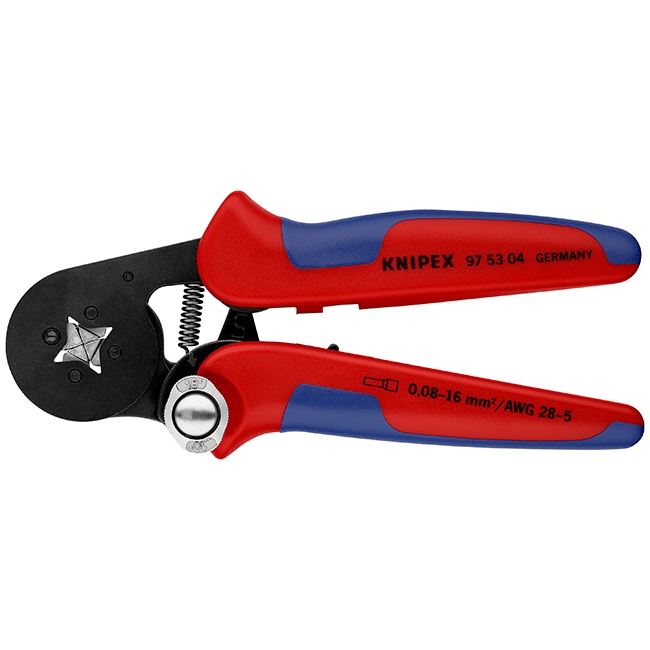 attach a wire to another connector, by deforming one or both pieces. This deformity is known as the crimp, and this is used to create a connection which can subsequently enable live current to flow. A crimping tool is used for this process and its purpose is to form a secure and reliable connection that will prevent shortages or faulty electrical connections.
In electrical work it is essential that tools are effective and reliable, and there is a big focus on repetitive work being practical and efficient, but also prioritising safety. The self-adjusting crimping plier with lateral access, such as the KN 97 53 04 SB supplied by Test Instrument Solutions, is a good example of this.
Understanding the self-adjusting crimping plier with lateral access
This is a professional grade tool used commonly by electricians working to connect wires and using small items such as wire ferrules (small, metal tubes crimped onto the stripped ends of stranded electrical wires to prevent the wire strands spreading, fraying and breaking). These crimping pliers are calibrated for accuracy and can be automatically self-adjusted to work with different wire and ferrule sizes. Once you have the correct size adjustment, a self-release locking mechanism ensures you can achieve high quality crimps on a repetitive basis, ensuring accuracy and reliability over multiple workpieces.
Wire end and ferrule range with self-adjusting crimping pliers can be from 0.08mm to 10mm, while a toggle lever ensures that the user can apply optimum force over an extended period, without experiencing hand fatigue. Crimping pliers tend to have shorter handles than other types of pliers, to recognise that work is often undertaken in confined spaces, such as control cabinets and electrical panels. This is where the term ‘lateral access’ comes from. The shorter handles enable the user to achieve lateral access, and to find the most suitable angle in a confined space, to approach wires and work on a crimp.
Features and benefits of self-adjusting crimping pliers
- Self-adjustment - The self-adjusting mechanism of this crimping tool eliminates the need for manual settings for the different wire or wire ferrule sizes you might encounter. This is an intelligent feature which ensures great consistency in your crimps and reduces the possibility of errors, making repetitive work much more efficient and effective.
- Hexagonal profile – The hexagonal crimping profile has been designed for precision and ensures you can work in the tight connection dimensions you will often encounter. The hexagonal design of the crimping profile is also ideal for achieving secure and reliable terminations.
- Ergonomics – Comfort and practicality is essential in an electrical testing tool as it ensures you can retain focus and achieve precision, without encountering fatigue, which could lead to errors and inconsistency. With self-adjusting crimping pliers, a narrow handle fits neatly into the hand and the lever action ensures optimum force with minimal effort. The hexagonal profile also ensures accuracy and reliability so that crimping actions don’t need to be repeated to be effective.
Quality self-adjusting crimping pliers from Test Instrument Solutions
The range of crimping pliers supplied by Test Instrument Solutions combines innovation, design quality and manufacturing excellence. These tools simplify work, create comfortable working conditions and provide the ability to create effective and reliable crimps to ensure electrical connection every time.
Please note that this section is for information purposes only. Anyone using equipment referred to in this section must be suitably qualified and/or experienced within the respective field. If in doubt before use, please consult a qualified electrician or engineer & thoroughly read all instruction booklets.