Insulation is the protection provided by an electrical device or equipment to prevent a hazard such as electrical shock or a short circuit. The insulation prevents contact with live electric currents by creating resistance to those currents, but insulation does degrade over time and can become ineffective, so insulation testing is a process of ensuring insulation resistance is sufficient to protect the user.
The insulation resistance tester, also known as a Meg-Ohmmeter, is a diagnostic tool used for this purpose and to verify the integrity of insulation used in electrical devices, parts, equipment, cables and motors. However, some of these models only measure up to a certain voltage, whereas professional insulation testers apply high voltage, usually in a range of 250 volts to 10 kV. For this reason, professional insulation testers are able to measure high resistance leakage current and identify potential failures caused by them before significant safety concerns are raised, or before considerable damage or downtime occurs.
Key features of high voltage insulation testers
- High voltage output – A professional insulation tester is able to generate DV voltages ranging between 250V and 10kV
- High resistance measurement
- Advanced diagnostics – Specialised tests such as PI and DAR
- Advanced safety features
- Data management – Models tend to have Bluetooth capability and therefore the user has the ability to store results and share or download results
The importance of high voltage insulation testers
High voltage insulation testers are an essential preventive maintenance tool for ensuring safety and regulatory compliance across your electrical system. The high voltage capability of a professional insulation tester means it can provide precise and reliable results, which ensure safety in systems such as transformers and cables, and hence exceed the capabilities of a general multimeter. Their advanced diagnostic features such as PI (Polarisation Index) and DAR (Dielectric Absorption Ratio) provide much deeper analysis and help electrical testers identify issues before failure occurs, which in turn ensures the system is stable and reliable.
The advanced features such as PI and DAR can detect moisture and other signs of aging in insulation, while another feature known as ramp testing can identify weaknesses by gradually increasing the test voltage until failure occurs. These tests provide valuable insight into the overall health and capabilities of the insulation, which other instruments cannot. You can also compare these results with capacitance and leakage current measurements to provide a thorough and reliable overview of the insulation condition. The results provided by the professional insulation tester are easy to view, share and download, making the unit convenient and very reliable.
Where would you use a high voltage insulation tester?
You could use a high voltage insulation tester in both commercial and industrial settings where high voltages are involved. Typically, these would be in substations, power plants and in high-voltage equipment maintenance. Professional insulation testers are known to offer a superior performance in terms of advanced diagnostics, safety features and data management, and for this reason they are often used where preventing costly breakdowns and downtime is essential.
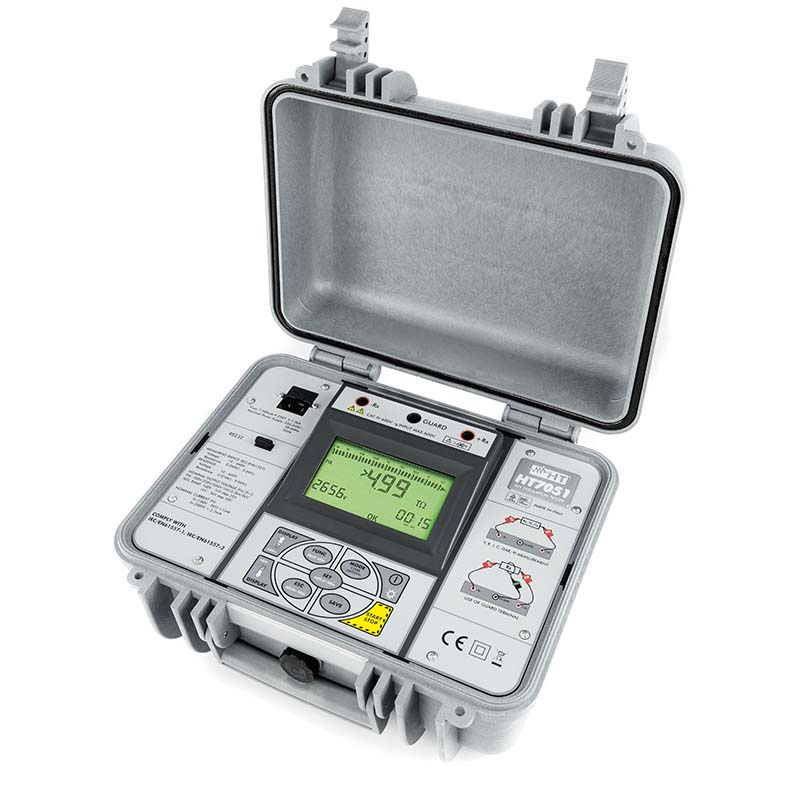
At Test Instrument Solutions we can supply the TIS HT7051 which is a 5kV professional insulation resistance tester.
Socket testers are an important safety mechanism and provide a simple indicator of a wiring fault. They are quick and easy to use and provide a critical first line of defence. However, some models can only detect basic wiring faults and cannot detect some others which are potentially more serious, such as earth neutral reverse, or resistance and impedance in a circuit.
At Test Instrument Solutions we have a range of fuse socket testers available.
Please note that this section is for information purposes only. Anyone using equipment referred to in this section must be suitably qualified and/or experienced within the respective field. If in doubt before use, please consult a qualified electrician or engineer & thoroughly read all instruction booklets.